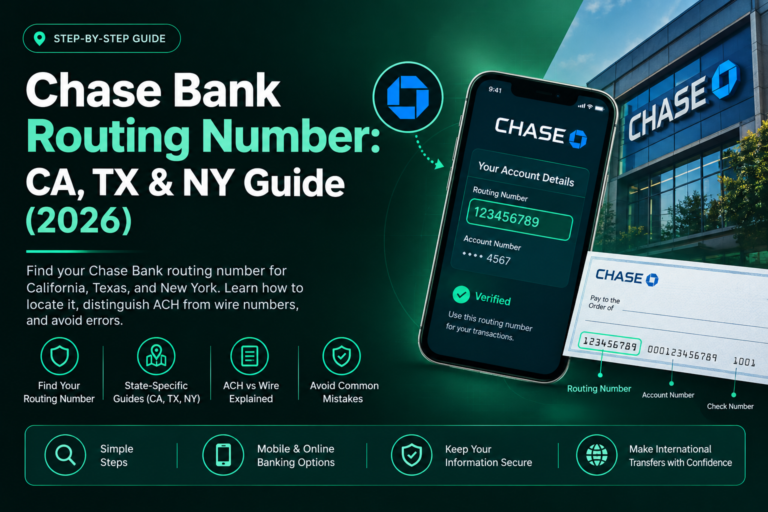

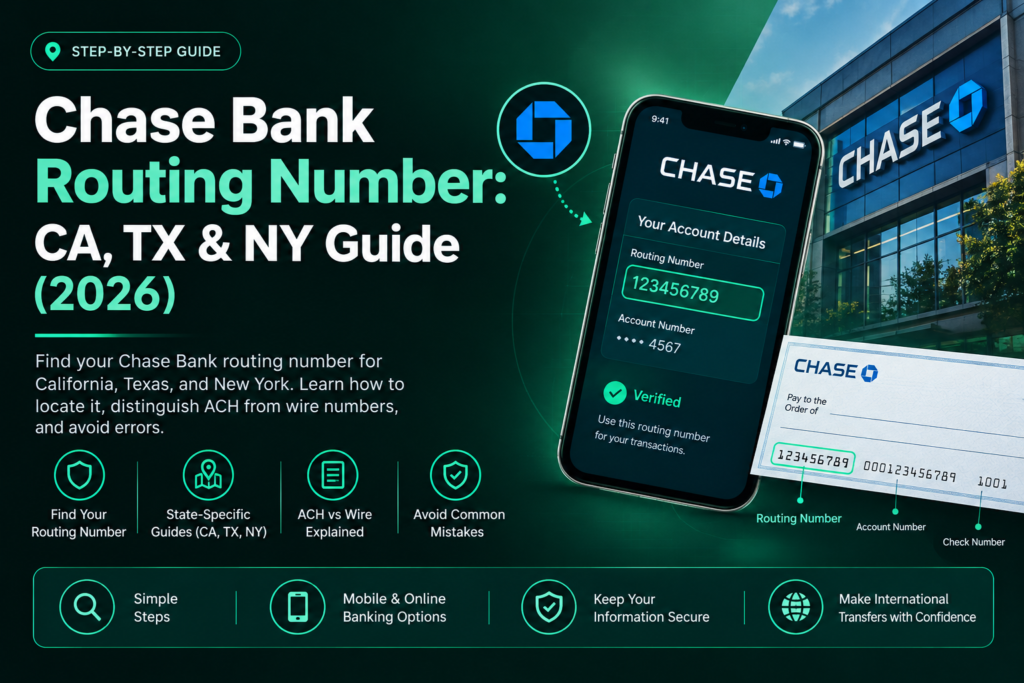
Need the Chase Bank routing number for direct deposit, an ACH payment, a domestic wire transfer, or another banking transaction? The correct number depends on your account and the type of transfer you are making.
Chase Bank routing numbers are nine-digit codes used to identify a financial institution for U.S. banking transactions. JPMorgan Chase Bank, N.A. uses different routing numbers for certain states and transaction types, so you should verify your number before submitting a payment.
In this guide, Remit Select explains how to find the Chase Bank routing number, how to check the routing number for California, Texas, and New York, and how to distinguish a routing number from an account number or SWIFT code.
Quick Answer: What Is the Chase Bank Routing Number?
There is no single routing number that applies to every Chase customer and every transaction. The correct number depends on factors such as your account’s applicable state routing number and whether you are making an ACH payment or a domestic wire transfer.
To find your correct Chase routing number, use the official Chase routing number lookup.
You can also sign in to the Chase Mobile app or Chase online banking, select your account, and open Show details to view your account and routing numbers.
Here is what to know before using the number:
- Direct deposit: Use the routing number specified for your account and the payment instructions.
- ACH transfers: Confirm the routing number for the relevant electronic payment.
- Domestic wire transfers: Verify the wire routing number separately.
- International transfers: You may need a SWIFT/BIC code and other recipient bank details rather than a domestic routing number alone.
Always confirm the number with Chase before initiating an important transaction.
Chase Bank Routing Number by State
Chase operates across multiple U.S. states, and its routing numbers can vary by location and transaction type. Customers commonly search for the Chase routing number in California, Texas, New York, and other states.
Use the official Chase lookup to identify the correct number for your account.
| State or location | What to check |
|---|---|
| California (CA) | California Chase routing number for your account and transaction |
| Texas (TX) | Texas Chase routing number for your account and transaction |
| New York (NY) | New York Chase routing number for your account and transaction |
| New York City (NYC) | Applicable New York routing number, verified with Chase |
| Florida (FL) | Florida Chase routing number for your account and transaction |
| Illinois (IL) | Illinois Chase routing number for your account and transaction |
| New Jersey (NJ) | New Jersey Chase routing number for your account and transaction |
| Other states | The routing number shown by Chase for your account and payment type |
Important: This table is a lookup guide, not a list of verified routing-number values. Do not assume that a number found on a third-party website is correct for your account.
California Routing Number for Chase Bank
If you are searching for the California routing number for Chase Bank, start with Chase’s official routing number page.
Searches such as “Chase Bank routing number California,” “California routing number Chase Bank,” and “routing number for Chase Bank in CA” all refer to the same general question: which routing number should a California Chase customer use?
The answer should be verified using your account details and the type of transaction.
Before setting up direct deposit or an electronic payment, check:
- Whether the payment is an ACH transaction or a wire transfer.
- Which routing number Chase specifies for your account.
- Whether the employer, payment service, or receiving institution has specific instructions.
If you have moved to California from another state, do not automatically assume that your existing account’s routing number has changed. Confirm the number shown in your Chase account.
Chase Bank Routing Number in Texas
Customers searching for “Chase Bank routing number in TX” should verify the applicable routing number through Chase’s official lookup or their online banking account.
The routing number needed for a direct deposit may not be the same number required for a domestic wire transfer.
If you are completing a payment form, follow the instructions provided by the employer, financial institution, or transfer service and verify the number with Chase.
Chase Bank Routing Number in New York and NYC
Searches for “Chase Bank routing number New York” and “Chase routing number NYC” generally indicate that a customer needs the correct routing number for an account associated with New York.
Do not assume that every Chase account in New York City uses the same routing number for every transaction.
Use the official Chase lookup and check the account details in online banking. If you are arranging a wire transfer, ask Chase to confirm the applicable wire instructions.
What Is a Bank Routing Number?
A bank routing number is a nine-digit identifier used to identify a U.S. financial institution for payment processing.
Routing numbers are also called ABA routing numbers because the American Bankers Association is associated with their assignment and administration.
Banks and payment systems use routing numbers for transactions such as:
- Payroll direct deposits
- Government benefit payments
- Tax refunds
- ACH transfers
- Electronic bill payments
- Domestic wire transfers, where applicable
A routing number identifies the financial institution or payment-routing destination. Your account number identifies your particular bank account.
According to Chase’s explanation of routing numbers, customers may need their routing and account numbers for electronic payments, direct deposits, and other banking transactions.
How to Find Your Chase Bank Routing Number
There are several ways to find your Chase routing number without guessing.
1. Use the Chase Mobile App
The Chase Mobile app is a convenient way to find your account information.
Follow these steps:
- Open the Chase Mobile app.
- Sign in to your account.
- Select the relevant checking or savings account.
- Tap Show details.
- Locate your routing number and account number.
The exact appearance of the app may change as Chase updates its interface.
For official instructions, visit Chase’s guide to finding account and routing numbers.
2. Sign In to Chase Online Banking
You can also find your routing number through the Chase website.
- Visit the official Chase website.
- Sign in securely.
- Open the account you want to use.
- Look for the account information or details section.
- Check the routing number displayed for that account.
Make sure you are using the official Chase website rather than an unfamiliar third-party page.
3. Look at the Bottom of a Chase Check
If you have a paper check, the routing number is typically the first nine-digit number printed along the bottom.
The numbers commonly appear in this order:
- Routing number: Usually the first nine digits on the bottom left.
- Account number: The next group of digits, identifying your particular account.
- Check number: The number used to identify the individual check, which may also appear elsewhere on the check.
The precise layout can vary, so use the printed labels and Chase’s official guidance if you are unsure.
Do not publish a photo of your check online. It can contain sensitive financial information.
4. Contact Chase Directly
If you cannot find the correct routing number, contact Chase using the official contact details on its website or the number on your bank card.
Ask the representative to confirm the routing number for your specific account and intended transaction.
This is particularly useful when you need a number for a domestic wire transfer, an international payment, or a transaction with specific banking instructions.
Chase Routing Number vs. Account Number
A routing number and an account number are different, even though both may be printed on the bottom of a check.
| Feature | Routing number | Account number |
|---|---|---|
| Main purpose | Identifies the bank or payment-routing destination | Identifies your particular account |
| Typical format | Nine digits in the U.S. | Length varies by account |
| Shared between customers? | May be shared by many customers | Unique to the individual account |
| Where to find it | Chase app, online banking, or check | Chase app, online banking, or check |
| Common uses | Direct deposit, ACH payments, and applicable wire transfers | Receiving or sending payments to or from your account |
For example, an employer may ask for both numbers to set up payroll direct deposit. The routing number identifies the appropriate banking destination, while the account number identifies the employee’s account.
Never substitute your account number for your routing number. Entering the wrong information can delay a payment or cause it to fail.
Is the Chase Routing Number the Same for ACH and Wire Transfers?
Not necessarily.
ACH payments and domestic wire transfers use different payment networks and may require different routing instructions. A number used for direct deposit should not automatically be assumed to be correct for a wire transfer.
ACH Transfers
ACH stands for Automated Clearing House. It is an electronic payment network used for many domestic payments, including payroll, recurring bills, and bank-to-bank transfers.
When setting up an ACH payment, use the routing number requested for that payment and verify it with Chase.
Domestic Wire Transfers
Domestic wire transfers use wire payment systems and can require different routing instructions.
Before sending a domestic wire, confirm the applicable wire routing number and any additional information required by Chase.
International Wire Transfers
For international transfers, the sending or receiving bank may require a SWIFT/BIC code, the recipient’s account details, and additional information depending on the country and payment route.
A U.S. routing number is not a universal replacement for international banking instructions.
Read Chase’s guide to SWIFT codes versus routing numbers to understand the difference.
What Is the Difference Between a Chase Routing Number and a SWIFT Code?
A routing number and a SWIFT/BIC code serve different purposes.
A routing number is used for identifying financial institutions in the U.S. banking system. A SWIFT/BIC code helps identify a financial institution for international payment messaging and related banking processes.
| Detail | Routing number | SWIFT/BIC code |
|---|---|---|
| Primary use | U.S. domestic payment routing | International bank identification |
| Typical format | Nine digits | Usually 8 or 11 alphanumeric characters |
| Common context | ACH, direct deposit, and applicable domestic wires | International wire transfers |
| Is it interchangeable? | No | No |
The exact information required for an international transfer depends on the sending bank, receiving bank, destination country, and payment method.
If you are sending money overseas from a Chase account, ask the sending institution or transfer provider which details are required.
Where to Find the Account Number on a Chase Check
The account number is generally printed along the bottom of a check, immediately after the routing number and before the check number in the standard layout.
However, the order and appearance of the printed numbers can vary depending on the check.
If you are unsure:
- Compare the check with Chase’s official check-number guidance.
- Open your account in the Chase Mobile app.
- Select Show details to view the account information.
- Contact Chase if you cannot confidently identify the correct number.
Remember that the check number is not the same as your bank account number.
Keep checks and account documents secure, and share your banking details only with trusted recipients or verified payment services that legitimately need them.
Common Reasons a Chase Routing Number May Not Work
If a payment form rejects your routing number or a transfer fails, several issues may be responsible.
1. You Entered the Wrong Routing Number
A typing error can cause a payment form to reject the number or route the payment incorrectly. Check all nine digits against the information provided by Chase.
2. You Used an ACH Number for a Wire Transfer
Different transaction types can require different routing instructions. Confirm whether the payment is an ACH transaction or a domestic wire.
3. Your Account Details Do Not Match
A payment may fail if the account number, account holder’s name, or other required details are incorrect.
4. The Payment Provider Has Different Requirements
An employer, payment processor, or transfer provider may ask for specific banking information. Follow the provider’s instructions and verify any uncertainty with Chase.
5. You Used Outdated Information
Routing information can change, and third-party websites may not reflect current bank instructions. Use Chase’s official routing number lookup rather than relying solely on an old search result.
If the problem continues, contact Chase or the payment provider before submitting the payment again.
How to Use Your Chase Account for International Money Transfers
A Chase checking account can be used to fund certain international transfers, depending on the bank’s services, the transfer provider, the destination country, and the payment method.
If you want to send money abroad, the routing number is only one part of the process. You should also consider the exchange rate, transfer fee, delivery time, and the amount the recipient will receive.
Before making a transfer, compare the following:
- Exchange rate: How much foreign currency you receive for each U.S. dollar.
- Transfer fee: The fee charged by the bank or transfer provider.
- Additional charges: Potential intermediary or receiving-bank fees.
- Delivery time: The estimated time for the recipient to receive the funds.
- Payment method: Whether you can fund the transfer directly from your bank account.
A provider advertising a low transfer fee is not necessarily the cheapest option. An exchange-rate markup can also affect the total cost.
Remit Select helps users compare money transfer providers and evaluate available rates, fees, and transfer details before deciding how to send money internationally.
Visit Remit Select to explore money transfer comparison options.
How to Keep Your Chase Banking Information Secure
Your routing number is not a password, but it should still be handled carefully alongside your other banking information.
Follow these practical precautions:
- Use the official Chase website or mobile app to access account information.
- Never share your online banking password, one-time verification codes, or PIN.
- Avoid uploading unredacted checks to public websites or social media.
- Verify the recipient and payment details before authorizing a transfer.
- Be cautious of emails or messages requesting urgent banking information.
- Contact Chase through a verified channel if you notice suspicious activity.
A routing number alone generally does not provide access to your online banking account. However, routing and account numbers can be misused in certain fraud scenarios, so protect them and monitor your account for unfamiliar transactions.
Frequently Asked Questions About Chase Bank Routing Numbers
What is the Chase Bank routing number?
Chase Bank does not have one routing number that applies to every account and transaction. The correct number depends on the applicable routing instructions and payment type. Use the official Chase routing number lookup to confirm your number.
What is the Chase Bank routing number in California?
To find the California routing number for Chase Bank, visit Chase’s official routing number page or sign in to the Chase Mobile app. Verify the number for your account and the transaction you intend to make.
What is the Chase Bank routing number in Texas?
Customers in Texas should use Chase’s official routing number lookup and confirm the number displayed for their account. Check separately if you are arranging a domestic wire transfer rather than an ACH payment.
What is the Chase Bank routing number in New York?
The applicable routing number for a Chase account associated with New York should be verified using Chase’s official lookup or account details. Do not assume that one number applies to every account and transaction in the state.
What is the Chase routing number for NYC?
For a Chase account in New York City, check the routing number shown in online banking or the Chase Mobile app. Confirm the number with Chase if you are making a wire transfer or have specific payment instructions.
How do I find my Chase routing number without a check?
Sign in to the Chase Mobile app, select your account, and tap Show details. You can also sign in to Chase online banking or contact the bank directly.
Is the Chase routing number nine digits?
Yes. U.S. ABA routing numbers consist of nine digits. However, you should still verify that the particular number is appropriate for your account and transaction.
Is the routing number on a Chase debit card?
The routing number is not typically printed on a Chase debit card. You can find it in your online banking account, the Chase Mobile app, or on a paper check.
Is the Chase routing number the same as my account number?
No. The routing number identifies the bank or payment-routing destination, while the account number identifies your specific account. Some transactions require both numbers.
Can I use my Chase routing number for direct deposit?
Yes, if you use the routing number designated for direct deposit or ACH payments for your account. Confirm the details with Chase and provide your employer with the correct account information.
Can I use my Chase routing number for a wire transfer?
You may need a different routing number for a domestic wire transfer. Confirm the applicable wire instructions directly with Chase before sending the payment.
Do I need a Chase routing number for an international transfer?
Not always. International transfers may require a SWIFT/BIC code, recipient account details, and other information. The exact requirements depend on the payment route and financial institutions involved.
Final Thoughts
Finding the correct Chase Bank routing number is essential when setting up direct deposit, making ACH payments, or arranging a domestic wire transfer.
The key is to verify the number for your account and payment type rather than relying on a generic list. If you are looking for the Chase Bank routing number in California, Texas, New York, or another state, Chase’s official lookup and online banking tools are the safest starting points.
If you are planning an international transfer, remember that the routing number is only one part of the process. Compare the exchange rate, fees, delivery time, and final amount received before choosing a transfer provider.
Remit Select helps people compare international money transfer options so they can make more informed decisions about sending money across borders.
Disclaimer: This article is for general informational purposes only. Banking instructions can change, and requirements vary by transaction. Verify your routing number and payment instructions directly with Chase before initiating a transfer.